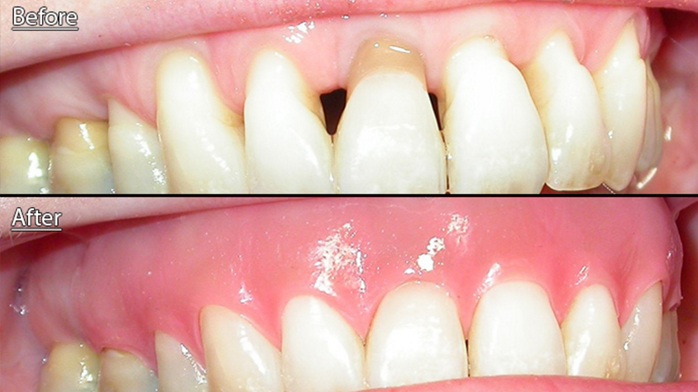
A patient completes periodontal treatment. The infection is controlled. The chart looks better. But the mouth the patient must live in may not.
Lost gum tissue can leave exposed roots, open spaces, food traps, altered speech, sensitivity, and a constant awareness that something is missing. Yet when patients ask what can restore the lost contour, the answer is often surgery, an expensive reconstruction—or nothing at all.
That last answer should be much harder to accept.
The option patients are rarely told about
A gingival mask—also called a gingival veneer, epithesis, or removable gingival prosthesis—is a thin appliance made to replace the appearance and contour of missing gum tissue. It does not regenerate tissue. It does not treat active disease. It rehabilitates what disease and treatment may leave behind.
The concept dates at least to 1955. Since then, clinicians have documented masks made from acrylic and flexible silicone, and more recently with digital scanning and design. Published cases describe their use after periodontal therapy for recession, sensitivity, food trapping, appearance, and comfort.
In other words: this is not a speculative invention awaiting proof that it can exist. It has existed for generations.
“The surgical treatment in such situations is costly, requires prolonged healing time, and the results are often unpredictable.”Patil et al., reporting on a flexible gingival epithesis after periodontal therapy
That sentence exposes the gap. If surgery can be costly, painful, slow to heal, or unpredictable—and if a patient is not a surgical candidate—then a removable prosthesis is not a frivolous afterthought. For many people, it may be the most conservative, accessible, and sensible path to restored contour.
Disease control is not the finish line
Periodontal care is rightly focused on stopping disease and preserving teeth. But success cannot be measured only in pocket depths and bleeding scores. The patient still has to speak, eat, manage saliva, tolerate the contours of the mouth, and live in public.
When those functions become harder after tissue loss, calling the result “stable” does not answer the rehabilitation question. Nor does labeling every concern cosmetic. Comfort, speech, food trapping, sensitivity, and the ability to smile without hiding are quality-of-life issues.
The profession already recognizes prosthetic rehabilitation everywhere else. Missing teeth are replaced. Missing facial structures are replaced. Lost contours are restored. Why, then, must a periodontal patient discover a gingival prosthesis by accident, after years of being told there is no option?
A gingival prosthesis can offer rehabilitation without another surgical wound, a long healing period, or a promise that lost tissue can be predictably rebuilt.
The failure is access
The problem is not that every patient qualifies. A responsible clinician must assess disease stability, tooth mobility, anatomy, hygiene, retention, bite, materials, and expectations. Some cases will not work. That is what evaluation is for.
The problem is that evaluation is often unavailable. Patients call periodontists, prosthodontists, dental schools, and laboratories and hear that the appliance does not exist, that no one makes it, or that their concern is merely cosmetic. They are left to search academic papers for a treatment that should have been discussed in the clinic.
A conservative option cannot help anyone if no referral pathway leads to it.
This is the demand.
Periodontal patients should be told that removable gingival prostheses exist. They should receive an informed evaluation—or an informed referral—from someone prepared to consider rehabilitation after disease control.
Add your voiceIf you are a patient, share this article with your oral-health professional and ask a direct question: Can you evaluate me for a removable gingival prosthesis, or refer me to someone who can?
If you are a clinician, technician, educator, or professional organization, help build the pathway. Publish the cases. Teach the technique. Identify the laboratories. Stop requiring patients to prove that a documented treatment is real before anyone will discuss whether it is appropriate.
Patients should not have to travel across a country—or across the world—to obtain a low-intervention prosthetic option that dentistry has known about since 1955. The knowledge exists. The appliance exists. What is missing is access, and the time to build it is now.
- Emslie RD. A case of advanced periodontitis complex. Dental Practitioner. 1955.
- Patil et al. Gingival prosthesis: a treatment modality for recession.
- Gopakumar and Sood. Conservative management of gingival recession: the gingival veneer.
- Choudhari et al. Gingival prosthesis: a viable treatment option for gingival recession.