For more than a decade, I have been undergoing periodontal treatment.
Deep cleanings. Costly procedures. Consultations. The ongoing commitment required to preserve my teeth and manage periodontal disease.
I did what patients are supposed to do. I sought care. I followed treatment recommendations. I invested in my oral health.
But the significant spaces between my teeth, commonly called black triangles, have remained a problem for which I have struggled to obtain meaningful help.
I have heard the reassurances.
“You look fine.”
“It’s normal.”
“Lots of people have that.”
“It’s not even noticeable.”
I have also been told that nothing can be done.
And yet, while searching for answers, I discovered something remarkable.
Dentistry has documented a removable prosthesis that replaces the appearance of missing gum tissue since 1955.
It has several names: gingival mask, gingival veneer, gingival prosthesis and gingival epithesis.
The appliance does not regenerate gums. It replaces the appearance and contour of tissue that has been lost. For suitable patients, it can offer a nonsurgical alternative to living with significant gingival recession and black triangles.
I found published clinical reports. I found photographs. I found fabrication techniques. I found dental laboratories advertising the product.
I even found studies in which patients reported improved confidence, comfort and satisfaction after receiving one.
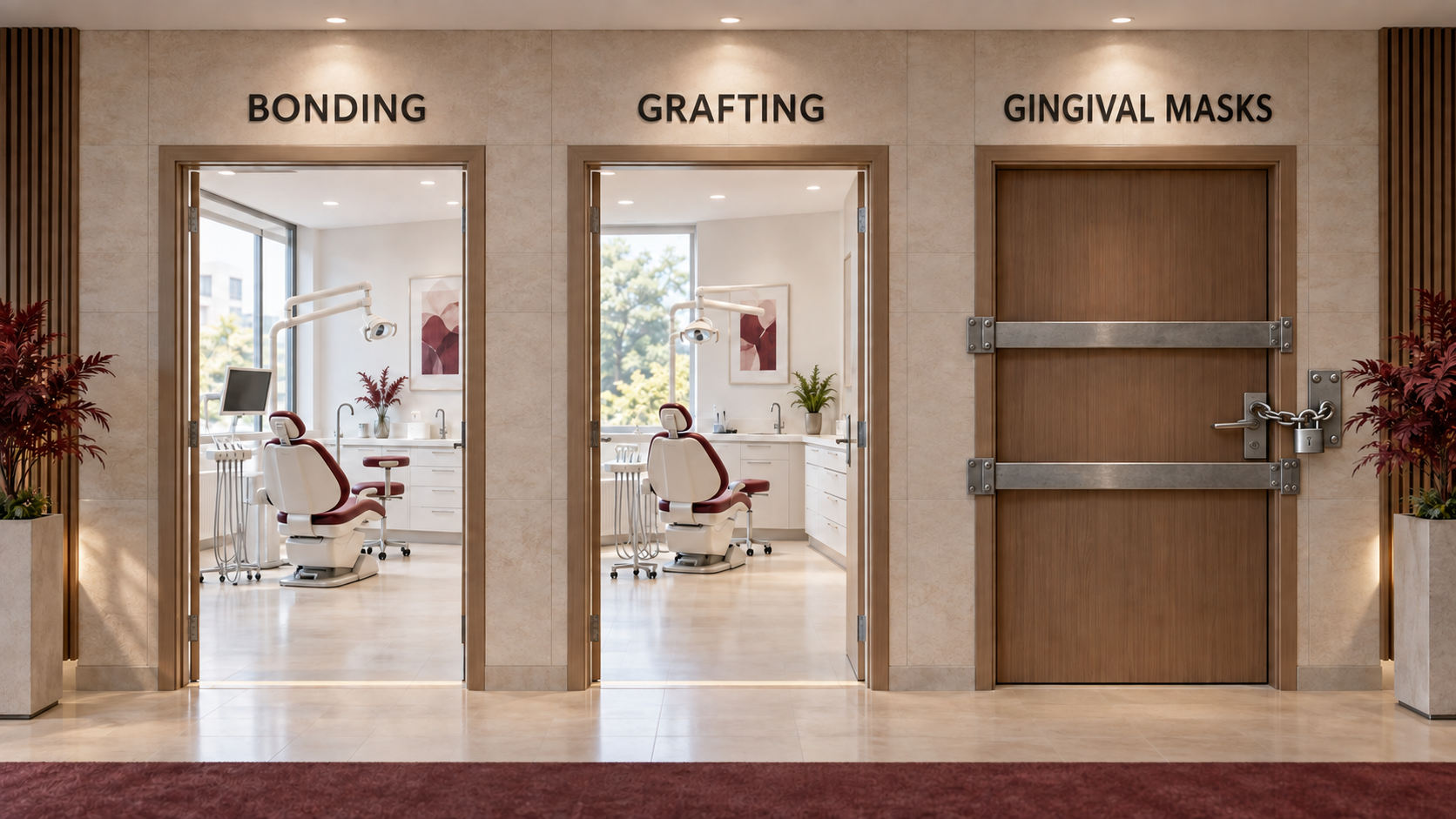
What I have not found is a dependable way to obtain one myself.
That contradiction is why I founded Black Triangles Help.
And the more I investigated, the more difficult it became to understand why patients are still struggling with a problem the profession has spent decades documenting.
The research exists. The appliance exists. The patients exist. So where is the treatment pathway?
First, Let’s Stop Pretending Black Triangles Don’t Matter
Black triangles are the dark spaces that appear between teeth when the gum tissue no longer fills the gaps.
They can develop as a consequence of periodontal disease, bone loss, changes in tooth position and other anatomical factors. They may become more apparent after periodontal treatment as inflammation resolves and the gums heal.
For some people, the spaces are small.
For others, they are substantial.
And for patients who experience significant visible tissue loss, the consequences may extend far beyond an unfamiliar appearance in the bathroom mirror.
Consider how much of everyday life involves showing your teeth.
Smiling. Laughing. Speaking. Eating with other people. Meeting someone new. Having your photograph taken.
Imagine becoming conscious of your mouth during activities that previously required no thought whatsoever.
Imagine managing the way you speak because you do not want to expose the spaces between your teeth.
Imagine avoiding photographs or social situations because you no longer feel comfortable smiling.
Not everyone with black triangles experiences them this way. But some of us do.
And importantly, dentistry’s own research demonstrates that black triangles are not some imaginary imperfection noticed only by overly self-conscious patients.
One of the most disliked dental appearance problems
In 2009, researchers Joanne Cunliffe and Iain Pretty asked 80 participants to evaluate black triangles alongside other common dental appearance problems.
Black triangles were ranked the third-most-disliked aesthetic problem, behind only visible tooth decay and crown margins.
The researchers concluded that black triangles were important to patients and should be discussed before relevant treatment. Cunliffe & Pretty, 2009
That is a significant finding.
Dentistry routinely provides treatment for conditions that affect the appearance of a smile. Yet black triangles ranked among the most disliked of the conditions examined.
And the evidence did not stop there.
In 2024, Al-Omiri and colleagues published a study involving 435 participants, including dentists, dental students and laypeople.
They evaluated smiles with different sizes and numbers of black triangles.
The smiles without black triangles received the highest attractiveness ratings. Those with multiple large black triangles received the lowest.
As the spaces became larger or more numerous, attractiveness ratings declined. Al-Omiri et al., 2024
Other researchers have used eye-tracking technology to examine how black spaces between teeth attract visual attention.
A 2021 study found that the spaces negatively affected aesthetic evaluations of the face and that visual attention to the mouth corresponded with the size of the visible space. Al-Lahham et al., 2021
These studies do not establish how much any particular patient should care about their appearance.
They establish that the appearance difference is recognizable and that people can respond negatively to it.
So when a patient tells an oral healthcare professional that their black triangles affect their confidence, perhaps the response should not be to explain why they should feel differently.
Perhaps it should be to ask what they would like to do about it.
The profession should not require patients to prove the significance of a condition its own researchers have already demonstrated.
Saving the Teeth Is Not Necessarily the End of Treatment
I want to make something clear.
This is not an argument against periodontal treatment.
Periodontal disease can destroy the structures supporting the teeth. Treating it is essential to preserving oral health.
That is why I have invested more than a decade in my own care.
But controlling the disease does not necessarily restore the tissue that has been lost.
When periodontal bone and attachment are lost, the gums may no longer be able to fill the spaces between teeth. Healing can also make existing tissue loss more visible.
This is established periodontal anatomy, not an unpredictable mystery. Tarnow, Magner & Fletcher, 1992
And the consequences are not always exclusively aesthetic.
The clinical literature associates significant gingival tissue loss with food trapping, exposed-root sensitivity, cleaning difficulties and changes in speech. Depending on the patient’s anatomy and the location of the missing tissue, unwanted airflow may also become a concern. Ankli et al., 2018 · Patil et al., 2011
These problems can persist even when the underlying periodontal disease has been successfully treated.
A patient can have healthier teeth and gums while remaining deeply dissatisfied with the appearance or function of their mouth.
That distinction matters.
It is possible to appreciate the importance of preserving your teeth while wanting help with the visible consequences of losing the tissue around them.
The two goals are not in conflict.
Disease control is treatment. Helping the patient live with the consequences of disease is rehabilitation.
Both deserve a place in oral healthcare.
The Treatment That Patients May Never Hear About
A gingival mask is a custom prosthesis designed to replace the appearance and contour of missing gum tissue.
Unlike a conventional denture, which replaces missing teeth, a gingival mask can be made for someone who still has their natural teeth but has lost significant amounts of the surrounding tissue.
The appliance is designed to fit against the teeth and remaining gums, concealing exposed areas and filling visible spaces.
Depending on the patient’s needs and the design of the prosthesis, it may help restore the appearance of the smile, improve speech and reduce food trapping.
It is removable, allowing the patient to clean both the appliance and the underlying teeth and tissues.
It can be fabricated using materials such as acrylic resin or silicone.
And for an appropriately selected patient, it can replace the appearance of substantial missing tissue without additional corrective surgery.
This is not a new invention.
- The modern record beginsR. D. Emslie reports a gingival veneer used after gingivectomy.
- Materials and clinical uses are reviewedBarzilay and Irene describe removable and fixed gingival prostheses across several clinical situations.
- A conservative treatment optionGopakumar and Sood describe gingival veneers as a feasible approach with potentially lower biological and financial costs.
- “Party gums” enter the published recordAgrawal, Dange and Khalikar document a removable gingival prosthesis made from flexible Valplast nylon.
- Implant recession is treated prostheticallyDiana Ankli and colleagues report a stable gingival veneer used around a malpositioned implant.
- The knowledge gap is measuredA survey of 446 dental professionals and students documents limited awareness and use of gingival veneer prosthetics.
Dentistry has known about gingival veneers since 1955
The gingival prosthetics literature traces the introduction of gingival veneers to R. D. Emslie’s 1955 report involving a patient who had undergone gingivectomy.
The appliance was used to conceal the undesirable appearance of gingival recession following the procedure.
Subsequent clinicians continued documenting the treatment, its fabrication and its potential applications. Gingival prostheses review
In 2003, the Journal of the Canadian Dental Association published a review by Izchak Barzilay and Tamblyn Irene describing several clinical situations in which gingival prostheses had been used effectively.
The review discussed different materials and designs, including removable and fixed approaches. Gingival prostheses—a review
In 2012, Gopakumar and Sood published a clinical article examining gingival veneers as a conservative approach to significant recession.
They described the treatment as feasible and simple in appropriate clinical circumstances, with potentially lower biological and financial costs than more extensive alternatives such as surgery, replacement crowns or extraction. Gopakumar & Sood, 2012
In 2014, Agrawal, Dange and Khalikar published The Flexible Party Gums: An Esthetic Alternative for Lost Gingiva. Their case report described a removable prosthesis made from Valplast, a flexible nylon-based material, to recreate lost gingival contours. Agrawal, Dange & Khalikar, 2014
The significance should not be lost on anyone reading this.
The underlying concept was documented before modern digital dentistry.
Before contemporary dental scanning.
Before the widespread use of CAD/CAM fabrication.
Before many of the technologies that have transformed restorative and prosthetic dentistry.
Yet here we are, more than 70 years later, with patients still struggling to locate an office prepared to provide the appliance.
And the most compelling evidence is not merely that the prosthesis can be fabricated.
It is what happened to the patients who actually received one.
What Happened When Patients Received Gingival Masks?
This is the part of the literature I wish had been presented to me when I first began searching for help.
Not simply descriptions of the materials or techniques.
The outcomes for the people who received the appliances.
Patients regained their smiles and confidence
In 2013, Antony and Khan published a case involving a young woman who received an acrylic gingival mask.
The researchers reported that the prosthesis helped restore her smile and confidence in facing other people.
At the reported two-year follow-up, she continued using the appliance comfortably, with virtually no problems encountered during that period. Antony & Khan, 2013
Think about that outcome for a moment.
This was not a patient undergoing extensive surgical reconstruction.
A prosthesis was fabricated to replace the appearance of missing gum tissue.
The resulting improvement was not limited to the physical appearance of her teeth.
It helped her feel comfortable facing other people again.
In another case, published in 2011, Patil and colleagues documented a removable gingival prosthesis used after periodontal treatment.
The authors reported that the appliance improved the patient’s appearance, significantly reduced sensitivity, prevented food trapping and improved speech. Patil et al., 2011
These are functional and aesthetic outcomes.
They address everyday experiences that may remain difficult after the underlying disease has been controlled.
In 2016, Tomar and colleagues published a case involving a woman with significant tissue loss following periodontal treatment.
The clinicians fabricated a removable silicone gingival prosthesis.
The patient adapted readily and was satisfied with the result. The clinical team also monitored her adaptation, plaque control and prosthesis hygiene during follow-up. Tomar et al., 2016
In 2018, Ankli and colleagues documented the use of a gingival veneer to address recession associated with a malpositioned dental implant.
The patient was satisfied with the aesthetic result. The authors reported that the prosthesis remained stable without compressing the surrounding periodontal tissues or requiring adjustment during the reported control phase. Ankli et al., 2018
These cases document something that deserves far greater attention.
Patients with significant gingival tissue loss have received removable prostheses and reported improvements in appearance, comfort, confidence or function.
The literature does not establish that every patient will benefit or that every prosthesis will achieve the same outcome.
Most gingival mask publications are individual clinical reports rather than large controlled studies.
But the documented results demonstrate that prosthetic replacement can be a practical option for suitable patients.
And that is precisely what patients like me have been trying to find.
We are not necessarily asking the profession to regenerate the tissue we have lost.
We are asking whether a removable prosthesis can help restore what the disease and its treatment have left behind.
Simple Does Not Mean One-Size-Fits-All
There is a reason I describe gingival masks as a relatively simple treatment.
The clinical literature itself has characterized them as conservative, practical and comparatively inexpensive in suitable situations.
They can replace the appearance of substantial tissue loss without requiring another corrective surgical procedure. Ankli et al., 2018 · Gopakumar & Sood, 2012
But simple does not mean that a patient can purchase an appliance online and expect it to work.
Proper fit matters.
Retention matters.
Periodontal stability and oral hygiene matter.
The prosthesis must be designed for the individual patient’s anatomy and fabricated using an appropriate material.
Some patients may not be suitable candidates.
Others may require additional treatment before prosthetic rehabilitation can be considered.
Different materials also have different maintenance needs. Some appliances may stain, lose flexibility or eventually require replacement.
And although the treatment may be less invasive or costly than certain alternatives, an affordable fabrication technique does not automatically translate into an affordable completed treatment for the patient.
Clinical fees, laboratory costs and future maintenance all matter.
These are legitimate considerations.
They are also reasons why qualified clinicians need to be involved.
The existence of limitations is not evidence that a treatment should remain inaccessible. It is evidence that patients need competent evaluations and informed guidance.
Dentistry Has Already Documented a Knowledge Problem
If gingival masks have been described for more than 70 years, why do so many patients struggle to find information about them?
A 2022 study published in The Open Dentistry Journal offers part of the answer.
Researchers surveyed 446 dental professionals and students in the Riyadh region of Saudi Arabia to examine their knowledge and use of gingival veneer prostheses.
The results were revealing.
Approximately seven in ten respondents across the surveyed professional and student groups did not practice gingival veneer treatment.
Among general practitioners who did not provide the treatment, more than half reported being unaware of the prosthesis.
But after participants were presented with its potential benefits, substantial majorities expressed willingness to recommend it in the future.
The researchers concluded that there was a significant knowledge deficit concerning gingival veneer prostheses, particularly among general practitioners, interns and dental students. Altaleb et al., 2022
This was a regional survey, not an investigation of the entire American dental profession.
It cannot establish how many clinicians in the United States provide gingival masks or how many American patients have difficulty obtaining them.
But it demonstrates that a knowledge problem exists within the profession.
A treatment can be documented, published and clinically demonstrated while remaining unfamiliar to professionals who encounter patients with the condition.
And when the patient cannot find someone who knows how to provide it, the distinction between an unavailable treatment and an unknown treatment begins to disappear.
Both can produce the same answer:
“Sorry, we can’t help you.”
Except that one situation may have a solution elsewhere.
The patient simply needs someone who knows where to send them.
A treatment does not become accessible merely because it exists in the literature.
I’ve Had the Consultations. I Still Don’t Have the Prosthesis.
This is where the published research meets my own experience.
For more than a decade, I have invested in periodontal care and undergone costly procedures.
My black triangles remain.
And my attempts to obtain meaningful help for them have led me through consultations, telephone calls and countless hours of research.
I have contacted dentists, periodontists, prosthodontists, orthodontists and dental laboratories.
I have contacted professionals outside the United States.
I have been told that the appliance does not exist.
I have been told that offices do not provide it.
I have been invited to pay for evaluations without discovering a complete route to the treatment I was asking about.
I have found laboratories advertising gingival prostheses.
But there is an important distinction between finding a laboratory capable of fabricating an appliance and finding a clinician prepared to provide the treatment.
The patient still needs someone qualified and willing to assess suitability, obtain an impression or scan, coordinate fabrication, deliver the completed prosthesis and make necessary adjustments.
That connection has been the recurring obstacle in my search.
I have yet to discover a dental office in the United States that offers me a complete, actionable pathway to the appliance I have been seeking.
I would welcome discovering one.
In fact, finding those offices is one of the primary purposes of Black Triangles Help.
But I cannot overlook what the search has revealed.
The problem is not necessarily that the treatment cannot be performed.
It is that the patient may have no practical way to connect with the people capable of performing it.
And it is unreasonable to expect every patient to spend years assembling that connection independently.
The receptionist is part of the access system
This deserves particular attention.
When a patient calls a dental office and asks about a gingival mask, the person answering the telephone may never have heard of one.
That is understandable.
Receptionists are not prosthodontists.
But they are often the first point of contact in a healthcare system.
If a patient cannot get past the telephone, whatever the clinician knows privately is functionally irrelevant.
An office does not need to provide every specialized treatment.
It does need a reasonable process for handling questions about services its staff cannot identify.
“Our office does not provide that treatment, but we can ask the doctor whether there is an appropriate referral.”
That is a useful answer.
“That doesn’t exist.”
That is a different matter.
The first identifies a limitation in the office’s services.
The second may send a patient away believing there is no treatment to seek.
And in this particular case, the literature has already established otherwise.
An Evaluation Should Lead Somewhere
No clinician should agree to provide a gingival prosthesis without examining the patient and determining whether the treatment is appropriate.
That is not what I am asking.
I am asking why patients must sometimes pay for appointments simply to discover that an office has no route to the treatment they specifically inquired about.
If someone contacts an office about a removable gingival prosthesis, shouldn’t the office be able to establish whether it provides that service, coordinates with a laboratory or has an appropriate referral relationship?
The patient may still require a comprehensive examination.
The treatment may ultimately be unsuitable.
But those possibilities do not prevent an office from explaining what services it is prepared to provide.
Is the office willing to evaluate the patient specifically for a gingival prosthesis?
Can it obtain an appropriate impression or scan?
Can it coordinate with a laboratory capable of fabricating the appliance?
Will someone deliver and adjust the completed prosthesis?
Or can the office refer the patient to a clinician who may be able to help?
Is the evaluation connected to a possible treatment pathway, or is it the price of discovering that there is no pathway?
Patients deserve to know the difference before spending more money.
Why Does “Cosmetic” Suddenly Mean It Doesn’t Matter?
Dentistry is a profession that understands the value of appearance.
Crooked teeth can be straightened.
Discolored teeth can be whitened.
Visible irregularities can be corrected with bonding.
Veneers can change the appearance of teeth.
Gum contouring can alter the way gingival tissue frames a smile.
Patients seek these treatments because they want to feel comfortable with their appearance.
And there is nothing inherently wrong with that.
Yet a patient seeking rehabilitation after substantial gingival tissue loss may encounter a very different conversation.
Their concern may be characterized as cosmetic, as though that classification settles the question of whether further care is worthwhile.
But calling something cosmetic does not eliminate its human consequences.
A person does not need to demonstrate a life-threatening condition to justify asking whether their appearance can be improved.
And significant gingival loss can involve more than appearance.
The gingival prosthetics literature documents potential benefits involving speech, sensitivity, food trapping and other functional concerns. Patil et al., 2011 · Ankli et al., 2018
Depending on the individual patient’s circumstances, an appliance may help address some of them.
I am not arguing that every gingival mask should automatically be covered by insurance or classified as medically necessary.
Those questions deserve their own investigation.
I am arguing that the word cosmetic should not prevent a meaningful clinical conversation.
Dentistry recognizes the value of improving a smile every day. That value should not disappear when the patient has lost gum tissue.
What I’m Asking the Oral Healthcare Profession to Do
I am not asking every dentist to become a specialist in gingival prosthetics.
I am not asking every periodontist to fabricate appliances.
And I am not asking anyone to provide a treatment for which they are unqualified.
I am asking for a dependable patient pathway.
One that allows someone with significant gingival tissue loss to discover whether a removable prosthesis is suitable and, if so, where they can obtain one.
Black Triangles Help is working to identify professionals and institutions willing to participate in five essential parts of that process.
- Evaluate: Determine whether a removable gingival prosthesis is appropriate for the individual patient.
- Impression or scan: Obtain the clinical information needed for fabrication.
- Laboratory coordination: Work with a qualified laboratory capable of producing the appliance.
- Delivery and adjustment: Assess fit, retention, appearance and function, and provide appropriate care instructions.
- Referral: When an office cannot provide the necessary services, help the patient identify an appropriate provider.
No single office necessarily needs to perform every step.
A periodontist may establish periodontal stability.
A restorative dentist or prosthodontist may undertake the clinical prosthetic work.
A laboratory may fabricate the appliance.
Different arrangements may be suitable for different patients.
What matters is that the pieces connect.
This is the purpose of Black Triangles Help.
To turn one patient’s search into a practical resource for others.
To identify professionals willing to help.
To document actual treatment pathways rather than simply collect more photographs of successful cases.
And to make information about removable gingival prostheses easier to find for people who may never have heard of them.
This is not a request for free care.
It is a request for accessible, informed care.
Patients should not have to become investigators to access the collective knowledge of the profession responsible for treating them.
The Question I Want Every Oral Healthcare Professional to Answer
Imagine someone sitting in your office after periodontal treatment.
Their disease has been controlled.
Their teeth have been preserved.
Their condition is sufficiently stable to begin discussing rehabilitation.
But they are unhappy with the appearance of their mouth.
They explain that the spaces between their teeth have changed the way they smile.
Perhaps food becomes trapped.
Perhaps their speech feels different.
Perhaps they simply want to feel comfortable showing their teeth again.
They have read about gingival prostheses.
They have seen the clinical photographs.
And they ask you:
“Can I get one?”
What happens next?
Does someone explain the option?
Does someone assess whether the patient is suitable?
Does the office know where to refer them?
Or does the conversation end because the service is unfamiliar, unavailable or outside the office’s usual scope of practice?
I am not suggesting that every patient who asks should receive a gingival mask.
I am suggesting that a patient who asks should have a reasonable opportunity to discover whether the treatment is suitable and where it may be obtained.
The profession has documented these appliances for more than 70 years.
It has published fabrication techniques.
It has reported successful patient outcomes.
It has studied the human impact of black triangles.
It has even documented knowledge gaps concerning gingival veneer treatment.
The next question is not simply whether another successful case can be published.
It is whether the existing knowledge can be translated into access.
Because somewhere today, a periodontal patient is looking in the mirror at significant spaces between their teeth and wondering whether this is simply how they must live from now on.
They may never have heard of a gingival mask.
They may never discover the clinical literature.
They may accept that nothing can be done because no one has told them otherwise.
And they may spend years believing that the only available choices are to accept their appearance or pursue additional procedures they do not want.
That is the patient I want this article to reach.
And that is the patient I want the profession to remember.
I have invested more than a decade in preserving my teeth.
I still want to preserve them.
But I also want to feel comfortable speaking, smiling and facing the world without constantly thinking about the spaces between them.
And if I eventually obtain my own gingival mask, I will continue this work.
Because my obtaining one will not answer the question for the next patient.
The research exists.
The appliances exist.
The patients exist.
It is time to build the pathway between them.
Help Build the Path
Black Triangles Help is a patient-led advocacy and access-mapping project for people affected by significant gingival tissue loss.
We are seeking periodontists, prosthodontists, restorative dentists, dental schools and laboratories willing to help patients access removable gingival prostheses.
Whether you can evaluate patients, take impressions or scans, coordinate fabrication, deliver and adjust appliances, or provide informed referrals, your participation can help turn decades of published knowledge into practical patient care.
If you are a patient affected by significant black triangles, your experience matters too.
Contact: del@blacktriangleshelp.com
Website: blacktriangleshelp.com
Del Perio is the founder of Black Triangles Help, a patient-led project documenting the human impact of significant gingival tissue loss and working to establish accessible pathways to removable gingival prostheses.
You are not vain, and you are not the only one.
Give us a mask so we can face the world again.